PART 1
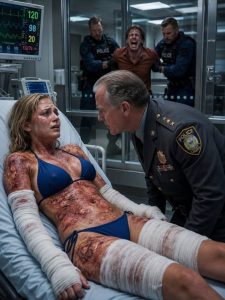
The first thing I remembered was my mother pounding on a window that would not open.
The second was blue fire racing across the ceiling.
Then I woke beneath white lights.
A machine beeped beside my head. Something cold moved through a tube in my arm. My chest felt as though steel wires had been wrapped around my ribs and tightened until breathing became punishment.
I tried to speak.
Only a dry sound escaped.
A nurse appeared immediately.
“Easy, Mara. You’re at St. Vincent Medical Center. You were unconscious for thirty-six hours.”
Thirty-six hours.
My eyes moved slowly across the room.
Flowers.
Medical equipment.
A television with the sound muted.
Then I saw my father.
Graham Vale sat in a chair beside the window, wearing the same dark gray suit he used for funerals and corporate board meetings.
The moment our eyes met, his face collapsed.
“Mara.”
He rushed toward me.
He dropped to his knees beside the hospital bed and took my wrapped hand between both of his.
For several seconds, he could not speak.
His tears fell onto the white gauze around my fingers.
“I thought I lost you.”
My throat burned.
“Mom?”
The word barely existed.
My father’s eyes closed.
That was when I knew.
“No.”
He shook his head.
“Dad…”
“I’m sorry.”
His voice broke perfectly.
“Your mother is gone.”
The hospital room disappeared around me.
I saw my mother laughing in our kitchen three days earlier.
I remembered her red reading glasses balanced on her head.
I remembered the ridiculous ceramic rooster she refused to throw away.
I remembered her calling me at midnight whenever she found a suspicious number in the family company’s financial statements.
Now she was gone.
My father pressed his forehead against my arm.
“You were found near the upstairs landing. The firefighters said another minute and…”
He stopped.
I stared at the ceiling.
“Was it an accident?”
My father hesitated.
Only half a second.
But numbers had trained me to respect small differences.
Half a second could expose a false invoice.
Half a cent could reveal a laundering network.
And half a heartbeat could tell you when someone had prepared an answer.
“The fire department thinks an old electrical panel overheated,” he said.
I looked at him.
“Electrical?”
“Yes.”
I remembered the smell.
Not smoke.
Something sharper.
Chemical.
I remembered crawling through the upstairs hallway while flames rolled along the walls.
I remembered reaching the back staircase.
The emergency door would not move.
I had pulled until the skin tore from my palms.
Locked.
From the other side.
My father squeezed my hand.
“Don’t force yourself to remember. The doctors said trauma can create false images.”
False images.
Interesting choice of words.
He had always done that.
When I was eleven and caught him removing cash from my mother’s desk, I had “misunderstood.”
When I was sixteen and heard him screaming at her behind the garage, I was “being dramatic.”
When I became a forensic financial investigator, he told relatives I “worked with calculators.”
My father never denied reality directly.
He simply edited it.
“You should rest,” he whispered.
I studied him.
His face was exhausted.
His eyes were swollen.
His expensive suit was wrinkled.
Everything looked correct.
Except his hands.
No burns.
No cuts.
No smoke irritation.
Nothing.
“I tried to get inside,” he said suddenly.
I had not asked.
“The heat was unbearable. I fought the firefighters. They had to restrain me.”
Again, I looked at his hands.
Perfect.
My father noticed.
For the first time, something behind his grief shifted.
Then the door opened.
A nurse entered carrying medication.
“Mr. Vale, we need to change your daughter’s dressings.”
My father stood.
He kissed my forehead.
“I’m arranging your mother’s memorial. You don’t need to worry about anything.”
He paused near the door.
“And Mara?”
“Yes?”
“You’re all I have left.”
The door closed.
The nurse waited.
Ten seconds.
Then she walked to the hallway and looked both directions.
A woman entered.
She was short, perhaps forty-five, with dark hair pulled into a severe knot. She wore a navy blazer over a plain white shirt.
No uniform.
No visible badge.
She closed the door.
“My name is Detective Naomi Serrano.”
She placed her identification beside my water glass.
I stared at it.
“What do you want?”
“For you to keep believing your father.”
My eyes narrowed.
Serrano pulled the chair closer.
“He’s putting on a performance.”
My heart became strangely calm.
“Explain.”
She opened a thin black folder.
The first photograph showed the ruins of our basement.
The second showed a metal pipe.
The third showed a small electronic device melted into the wall near our heating system.
“Your house didn’t burn because of an electrical panel,” Serrano said.
I said nothing.
“The explosion was initiated remotely.”
My fingers tightened beneath the bandages.
She showed me another photograph.
A traffic camera image.
My father’s silver Mercedes.
Timestamp: 10:41 p.m.
Our house exploded at 10:53.
“He told investigators he was in the garden when the explosion happened,” Serrano said. “He claimed he ran toward the house.”
I stared at the photograph.
The car was crossing the Hawthorne Bridge.
Six miles away.
“He lied.”
“Yes.”
“Then arrest him.”
Serrano leaned back.
“We can’t.”
“Why?”
“Because someone altered the municipal camera database fourteen minutes after we downloaded that image.”
My eyes moved to her face.
“What do you mean?”
“The original footage is gone.”
“But you have the photograph.”
“A photograph his lawyers will call an unauthorized screenshot with no verified digital chain of custody.”
I understood immediately.
“Someone inside the department helped him.”
“We believe so.”
My father was not a criminal mastermind.
He was worse.
He was wealthy.
Wealth did not need genius.
It rented genius.
“Why kill my mother?”
Serrano opened another folder.
“Three months ago, your mother discovered irregular transfers from Vale Meridian Holdings.”
My father’s company.
“How much?”
“Approximately forty-two million dollars.”
That number changed everything.
My mother had asked me about offshore shell structures six weeks earlier.
She pretended it was curiosity.
I had sent her an article.
She had replied with a single heart.
Now I understood.
“She found something.”
“We think she was preparing to expose him.”
Serrano placed a photograph of my mother on the blanket.
It had been taken outside a law office.
“She met a federal prosecutor four days before the fire.”
I closed my eyes.
A memory surfaced.
My mother standing in my apartment.
Rainwater on her coat.
Her hands trembling as she held a small brass key.
“Mara, if I ever ask you to look at something, I need you to promise you won’t tell your father.”
I had laughed.
I thought she was being paranoid.
I promised anyway.
“Detective.”
Serrano waited.
“My mother gave me a key.”
Her expression changed.
“To what?”
“I don’t know.”
“Where is it?”
I looked toward the window.
“My apartment.”
Serrano became silent.
Then she stood.
“We need to move you.”
“No.”
“Mara—”
“If my father arranged the fire, he’ll know I’m the only surviving witness.”
“Exactly.”
“He’ll also know police suspect him the moment you move me.”
Serrano stared at me.
I had spent twelve years investigating corporate fraud.
People imagined my job involved spreadsheets.
It did.
But numbers were only footprints.
My real job was understanding predators.
Predators became careless when they believed prey was injured.
“I need him comfortable,” I said.
“What are you suggesting?”
“Tell him my memory is fragmented.”
Serrano’s jaw tightened.
“That’s dangerous.”
“Tell him I remember flames, screaming and nothing else.”
“Mara.”
“And tell him the doctors believe the memories may never return.”
She studied me.
“You want to become bait.”
“No.”
I looked at my mother’s photograph.
“I want him to believe the fire worked.”
That afternoon, my father returned.
He brought lilies.
My mother’s favorite flowers were peonies.
He had been married to her for thirty-one years.
He still got it wrong.
I smiled when he entered.
“Dad.”
His shoulders relaxed.
The performance began again.
He sat beside me.
I told him I could not remember the explosion.
I told him the detective had asked confusing questions.
I told him I was frightened.
Then I asked the most important question.
“Dad, can I stay with you after I’m discharged?”
For one second, pure relief appeared on his face.
“My home is your home.”
I squeezed his hand.
“I don’t want to be alone.”
“You won’t be.”
He leaned forward.
“I’ll protect you.”
I smiled.
And somewhere beneath the white hospital blanket, my nails dug into my palms.
Because my father did not know one thing.
My mother had taught me never to trust a lock.
And I had hidden a duplicate key.
Three days later, Detective Serrano entered my apartment disguised as a building inspector.
The brass key opened a private deposit box at Calder Street Station.
Inside was no money.
No jewelry.
No flash drive.
Only a photograph.
My mother.
My father.
And a third man.
On the back, my mother had written six words.
THE FIRE STARTED TWENTY YEARS AGO.
Serrano sent me the image.
I stared at the third man’s face.
I knew him.
Everyone in the country knew him.
Federal Judge Elias Ward.
The man currently leading the national anti-corruption commission.
And the man scheduled to speak at my mother’s funeral.
That was when I understood.
My father was not hiding forty-two million dollars.
He was hiding the people who had helped him steal it.
But as I enlarged the photograph, I noticed something reflected in the window behind them.
A woman.
Young.
Blonde.
Watching the three men.
My breath stopped.
Because she had my eyes.
And my mother’s face.
At the bottom of the photograph, written in faded ink, was a date.
June 18, 1998.
Three years before I was born.
Then my phone rang.
My father.
I answered.
“Mara,” he said softly, “I hope Detective Serrano found what she was looking for.”
I froze.
My father laughed.
Then the hospital lights went out.
PART 2
Darkness swallowed the room.
For several seconds, I heard nothing except the monitor beside my bed.
Beep.
Beep.
Beep.
Then the emergency lights activated.
A weak red glow filled the hospital corridor.
My father remained on the phone.
“You always were curious,” he said.
My mouth became dry.
“Where are you?”
“Closer than you think.”
The call ended.
I immediately pressed the nurse button.
Nothing happened.
The door opened.
I expected my father.
Instead, Detective Serrano entered carrying a compact flashlight.
“We’re leaving.”
“You were followed.”
“I know.”
She locked the door.
“The hospital security system was remotely disabled ninety seconds ago.”
“My father?”
“Maybe.”
That word frightened me more than yes.
Serrano helped me from the bed.
Pain exploded through my ribs.
My legs nearly collapsed.
“You can barely walk.”
“I’ll manage.”
She gave me a dark coat to cover the hospital gown.
We entered a service corridor.
The elevator was dead.
Serrano led me toward a maintenance staircase.
Halfway there, footsteps echoed behind us.
Slow.
Unhurried.
Serrano pushed me through a door.
We entered a medical storage room.
She turned off the flashlight.
The footsteps stopped outside.
I could hear my own breathing.
The handle moved.
Once.
Twice.
Then silence.
A phone vibrated somewhere beyond the door.
Footsteps retreated.
Serrano waited thirty seconds.
Then she whispered, “Move.”
We reached the underground ambulance bay.
An unmarked vehicle waited near the exit.
Serrano placed me inside.
A man sat behind the wheel.
I recognized him.
Judge Elias Ward.
My blood turned cold.
I reached for the door.
Serrano stopped me.
“Wait.”
Ward looked at me through the mirror.
“You look like your mother.”
“You knew her.”
“Yes.”
“Did you help my father?”
Ward’s expression remained unreadable.
“For many years.”
Serrano sat beside me.
I stared at her.
“You brought me to him?”
“I brought you to the only man your father is afraid of.”
Ward drove.
No one spoke for nearly twenty minutes.
We left the city.
Eventually, the car turned onto an abandoned industrial road and stopped beside an old textile factory.
Inside, Serrano led me into a small office.
Photographs covered the walls.
Bank executives.
Politicians.
Police officials.
Judges.
My father’s face appeared repeatedly.
Red lines connected names to companies.
Companies to accounts.
Accounts to foundations.
At the center was my mother’s photograph.
“What is this?”
Ward removed his coat.
“Your mother’s investigation.”
“My mother wasn’t an investigator.”
Ward almost smiled.
“That’s what Graham believed.”
He opened a cabinet.
Inside were dozens of financial files.
“Twenty years ago, your mother discovered that your father was moving money for a private network of influential clients. Bribes. Illegal political funds. Corporate theft.”
“Why didn’t she expose him?”
“Because she became pregnant.”
I looked at him.
“With me?”
Ward shook his head.
The blonde woman in the photograph.
My stomach tightened.
“Who was she?”
Ward walked toward the wall.
He removed a photograph.
The same blonde woman.
Her name was written beneath it.
ELENA VALE.
“My father’s sister?”
“No.”
Ward looked directly at me.
“Your father’s first daughter.”
The room became silent.
“My sister.”
“Half-sister.”
I could barely process the words.
“She died?”
“We thought so.”
Ward handed me a police report.
A car accident.
No body recovered.
Elena Vale, age twenty-one.
Presumed dead.
“The accident happened after Elena discovered one of your father’s accounts,” Ward said.
I looked at Serrano.
“You think he killed his own daughter?”
“We think he tried.”
My skin went cold.
“Then who was reflected in the photograph?”
Ward answered quietly.
“Elena.”
“After the accident?”
“Yes.”
“She survived.”
“Yes.”
“Where is she?”
Nobody answered.
That was when I understood.
“You don’t know.”
Ward looked away.
My mother had spent twenty years collecting evidence.
Not simply against my father.
She had been searching for Elena.
I walked slowly toward the financial wall.
Pain stabbed through my chest.
I ignored it.
Forty-two million dollars.
My mother’s investigation.
Elena’s disappearance.
The fire.
The altered security footage.
They were not separate crimes.
They were one structure.
I studied the account names.
Then I saw something.
A transfer pattern.
Amounts ending in unusual sequences.
I grabbed a marker.
“What are you doing?” Serrano asked.
“Dates.”
I wrote them down.
April 17.
September 21.
More transfers.
More numbers.
I rearranged them.
Coordinates.
Ward stepped closer.
“Coordinates to where?”
I entered them into a map.
The location appeared.
A private property eighty miles north.
Registered to a charitable foundation.
The foundation’s director was my father.
Serrano looked at me.
“What is there?”
I stared at the satellite image.
A house surrounded by forest.
“I think my sister is there.”
We arrived after midnight.
Serrano wanted backup.
Ward refused.
He believed someone inside law enforcement was feeding information to my father.
So we entered alone.
The property appeared abandoned.
No exterior lights.
No vehicles.
The front door was unlocked.
Inside, dust covered the furniture.
I walked through the kitchen.
Then I noticed the refrigerator.
Fresh milk.
Fresh vegetables.
Someone lived there.
A sound came from upstairs.
Serrano raised her weapon.
We climbed slowly.
The second-floor hallway contained four rooms.
Three were empty.
The fourth was locked.
I touched the handle.
“Elena?”
Silence.
“My name is Mara.”
Something moved inside.
“I think Graham Vale tried to kill you.”
A woman’s voice answered.
“He tried to kill you too.”
My heart stopped.
Serrano forced the lock.
The door opened.
A blonde woman stood near the window.
She was older than the woman in the photograph.
Thin.
Pale.
But alive.
She looked at me.
My eyes.
My mother’s face.
Tears appeared immediately.
“Mara.”
“You know me?”
Elena laughed softly.
“I’ve watched you grow up.”
I stepped backward.
“What?”
She opened a drawer.
Inside were photographs.
My school graduation.
My first apartment.
My university ceremony.
My office.
Someone had been watching me for years.
“Why?”
“To keep you alive.”
Elena moved closer.
“Our father knew your mother was investigating him. He knew she had recruited you without telling you.”
“My mother never recruited me.”
“Yes, she did.”
Elena touched my forehead gently.
“Every puzzle she gave you as a child. Every accounting game. Every lesson about patterns.”
I remembered.
My mother hiding numbers around the house.
Teaching me to find inconsistencies.
I thought they were games.
“She trained me.”
Elena nodded.
“She knew one day Graham would come for her.”
My eyes filled with tears.
“Why didn’t she tell me?”
“Because you cannot betray a secret you don’t know.”
Then headlights appeared outside.
Serrano ran to the window.
Three vehicles entered the property.
Ward swore.
“We were followed.”
Elena did not look frightened.
She smiled.
“Good.”
I stared at her.
“What?”
She walked downstairs.
We followed.
Outside, car doors opened.
Men in dark clothing surrounded the house.
Then my father stepped from the center vehicle.
No tears.
No trembling shoulders.
No grieving husband.
Graham Vale looked exactly like the man my mother had feared.
He entered the house alone.
His eyes moved from Elena to me.
For the first time in my life, my father looked genuinely surprised.
“Elena.”
My sister smiled.
“Hello, Dad.”
He looked at me.
“Mara, you have no idea what these people are doing.”
I laughed.
“Still editing reality?”
His face hardened.
“You think your mother was innocent?”
The room became silent.
My father reached inside his coat.
Serrano raised her weapon.
“Hands where I can see them.”
He slowly removed an envelope.
He placed it on the table.
“Mara, before you destroy me, you should understand why the fire happened.”
“You killed Mom.”
“Yes.”
The confession hit me harder than expected.
My knees nearly failed.
My father continued.
“But I didn’t kill her because of the money.”
He pushed the envelope toward me.
“She was going to kill you.”
I stared at him.
Elena’s expression changed.
For the first time, she looked afraid.
I opened the envelope.
Inside was a medical document.
My name.
My date of birth.
And a genetic report.
I read the first page.
Then the second.
My hands began shaking.
“No.”
My father watched me.
“Your mother wasn’t searching for Elena.”
I looked at my sister.
Elena stepped backward.
My father smiled.
“She was searching for you.”
I could barely breathe.
“What does that mean?”
He pointed at the genetic report.
“Read the final line.”
I did.
SUBJECT MARA VALE: MATERNAL RELATIONSHIP EXCLUDED.
My mother was not my biological mother.
I looked at Elena.
She was crying.
Then I understood why we had the same eyes.
Why she had photographs of my entire life.
Why my mother had trained me to follow money.
Why my father had burned the house.
I whispered the question.
“Elena… who am I?”
My half-sister wiped her tears.
Before she could answer, every phone in the room vibrated simultaneously.
A message appeared.
One photograph.
My mother.
Alive.
Sitting in a dark room.
Today’s newspaper rested on her lap.
Beneath the photograph were five words.
MARA, DO NOT TRUST ELENA.
I slowly raised my eyes.
Elena was no longer crying.
She was smiling.
And behind me, Detective Serrano quietly locked the front door.