He Lied to Dinner Guests While I Labored in a Basement Cage
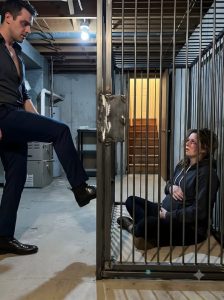
The man with the body camera said my sister’s name again, slower this time, as if he understood that I needed proof he had not come from Marcus.
“Your sister sent us,” he said. “We know who you are.”
Marcus stepped between him and the cage, spreading his arms like the basement belonged to him and everyone else was trespassing.
“My wife is having some kind of episode,” he said. “She’s pregnant, confused, and dangerous to herself.”
The officer’s gun remained pointed at the floor, but his voice hardened.
“Move away from her.”
Marcus did not move until a second officer came through the broken doorway and pulled him backward, turning him toward the concrete wall and securing his hands.
The confidence Marcus had carried downstairs vanished into frantic explanations about privacy, marriage, and misunderstandings.
I pressed both hands beneath my stomach as another contraction tightened through my back.
“Under the floor,” I said.
The first officer crouched beside the cage, keeping his eyes on my face.
“What’s under the floor?”
“My phone. Loose panel. Left corner.”
He found the metal edge and lifted it carefully, revealing the phone wrapped in cloudy plastic.
The battery symbol glowed red when he woke the screen.
Marcus twisted against the officer holding him.
“That isn’t hers,” he shouted. “She planted that. You don’t understand what she does when she’s unstable.”
I gave the officer the passcode and told him to open the recordings.
He did not play them aloud.
He checked that the files were there, locked the screen, and placed the phone inside a clear evidence bag while I watched.
“Please don’t let it die,” I said. “Everything is on there.”
“We have it,” he answered. “You did your part.”
Footsteps pounded down the stairs, and Marcus’s mother appeared in the doorway with the gold chain bouncing against her church dress.
The key hung at the center of her chest.
“I can open it,” she said quickly. “I’ve been taking care of her.”
She reached for the chain, but the officer stopped her before she touched the cage.
The door was no longer merely locked.
A fresh silver seam ran around the latch where Marcus had welded it shut.
Her key had controlled my life for weeks, but that night it could not free me even if she suddenly decided to pretend she wanted to.
“She had that key every day,” I told the officer. “She decided when I ate. She decided when I drank.”
Marcus’s mother stared at me with the same cold expression she had worn whenever she stood outside the bars.
Then she looked toward the officers and softened her face.
“My son made me do things,” she said. “I was afraid of him too.”
One of the real dinner guests had followed the noise to the basement stairs.
She stood behind the officers with one hand over her mouth, looking from the gold key to the cage and then to the empty apple tray on the floor.
Only minutes earlier, she had been eating at Marcus’s table while he explained that I was visiting family.
Now she could see exactly where I had been.
The officers cleared everyone except the emergency crew from the basement, and a cutting tool screamed against the welded metal.
Sparks jumped across the concrete while one responder shielded me with a heavy blanket and another spoke to me through the bars.
He asked how close the contractions were, whether I could feel the baby moving, and whether I could stay awake.
I answered until my voice stopped sounding like mine.
The cage door finally bent outward.
A responder crawled inside, covered me, and helped slide me onto a stretcher without asking me to stand.
As they carried me upstairs, I passed the dining room where Marcus’s guests had left their plates.
Steam still rose from the food.
A wineglass lay on its side beside Marcus’s chair, and the napkin at my empty place had been folded neatly beneath the silverware.
He had prepared the room to make my absence look ordinary.
Instead, every person at that table had become a witness to the lie.
My sister was outside near the ambulance.
She tried to run toward me, but a responder held her back until the stretcher was secured.
Her face was swollen from crying, and she kept saying my name as though each repetition could pull me farther from the basement.
I had spent days believing she ignored the message.
The truth was that she had understood it.
She had not replied because she was afraid a notification sound or a glowing screen would tell Marcus I still had a phone.
She saved the location pin, copied the audio file, and contacted emergency services from another device so she could keep her own line open.
Before the officers entered the house, she gave them one instruction.
“Say my name to her,” she told them. “Otherwise she may think Marcus sent you.”
That was why the first officer used it before asking me anything else.
My sister’s silence had not been abandonment.
It had been the first safe thing anyone had done for me in weeks.
The baby arrived soon after they brought me to the hospital.
The delivery room filled with clipped instructions, warm blankets, monitor tones, and hands that touched me only after telling me what they were about to do.
That small courtesy nearly broke me.
For three weeks, every hand near my body had meant hunger, punishment, or humiliation.
Now a nurse asked permission before adjusting a blanket.
My baby needed monitoring, and I needed treatment for dehydration, malnutrition, bruising, and the injuries around my wrists, but we were alive.
My sister sat beside the bed with a paper coffee cup cooling between her hands.
She did not tell me to be strong.
She helped me drink water one careful sip at a time, held the cup when my hands shook, and stayed awake whenever I woke in panic.
Before Marcus locked me in the basement, he had spent months making my sister seem like the problem.
He complained when she called during dinner, accused her of interfering in our marriage, and told me that pregnancy had made me too emotional to recognize disrespect.
When he began answering my phone for me, he said he was protecting my rest.
When he stopped driving me to see her, he said the trips were bad for the baby.
When his mother moved into the house, he said I needed another woman nearby.
Each restriction arrived disguised as care.
By the time he took my phone completely, he had trained me to apologize for wanting ordinary privacy.
My sister had known something was wrong, but she did not know how far it had gone until the broken message reached her.
The audio clip was only a few seconds long.
It contained Marcus striking the bars, my breathing, and his voice warning me that no one knew where I was.
That was enough to bring help.
The full phone showed everything else.
In his first interview, Marcus claimed the cage had been part of a private arrangement between us.
He said I entered voluntarily after becoming unpredictable and that the food restrictions were an exaggeration caused by my confused memory.
His mother offered a softer version of the same lie.
She said the cage was temporary, that I always had water, and that she wore the key only so Marcus could not misuse it.
The recordings did not merely contradict them.
They captured the routine they had built around my suffering.
There was Marcus counting the seconds while I begged for water.
There was his mother telling him to wait longer because begging taught gratitude.
There was the scrape of the rotten apples across the metal floor.
There was Marcus forcing me to watch videos while he insulted me, followed by his mother laughing after she thought the recording device was gone.
The most important file had been created on the morning of the dinner.
I had started recording when I heard them outside the cage discussing the guest list.
Marcus’s mother asked, “What if labor starts tonight?”
Marcus answered, “Then everyone upstairs will remember she was already gone.”
After a pause, his mother told him to repeat the visiting-family story before dinner so the guests would hear it more than once.
That recording changed the meaning of the entire evening.
The dinner was not simply bad timing.
They had filled the house with people because they wanted witnesses to a version of events that erased me before anything happened in the basement.
Marcus expected polite conversation, full plates, and repeated lies to become protection for him.
He never imagined the people sitting at his table would later describe the exact words he used, the time he left the dining room, the impact that shook the floor, and his calm expression when he returned.
One guest remembered asking whether I would be back before the baby came.
Marcus had smiled and said my family wanted me to stay with them through the delivery.
Another guest recalled his mother touching the gold key whenever anyone mentioned my empty chair.
At the time, the gesture meant nothing to them.
After they saw the cage, they could not forget it.